Evaluating Bizartum: A Distinctive Victorian Font for Classic Branding
Selecting the right typography for a brand identity is rarely about finding the most legible option; it is about finding the typeface that conveys the correct historical narrative and emotional texture. In the realm of vintage-inspired design, particularly for sectors like spirits, artisanal goods, and retro hospitality, the demand for authenticity often outweighs the need for modern polish. Bizartum emerges in this space as a specialized Victorian-style font that distinguishes itself through specific structural imperfections. Unlike many digital revivals of 19th-century typography that sanitize the original character for screen readability, Bizartum retains a raw, hand-pressed aesthetic defined by its lack of solid strokes and unique internal geometry.
For designers and brand managers evaluating resources for a new project, understanding the nuanced differences between standard vintage fonts and distinct options like Bizartum is crucial. This analysis explores the specific characteristics of Bizartum, its ideal applications, and the trade-offs involved when choosing it over more conventional alternatives.
The Anatomy of Authenticity: What Sets Bizartum Apart
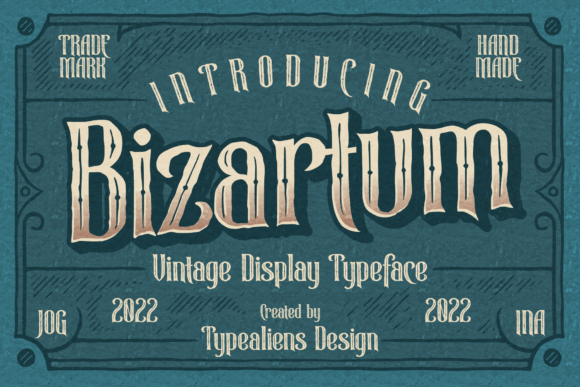
The primary differentiator of Bizartum lies in its deliberate departure from vector perfection. Most contemporary fonts, even those styled to look old, are constructed with solid, continuous strokes to ensure clarity across various resolutions. Bizartum rejects this convention. Its edges are intentionally uneven, mimicking the ink bleed and paper texture of antique letterpress printing. This "not neat" quality is not a defect but a feature designed to evoke a sense of age and craftsmanship.
Furthermore, Bizartum incorporates a distinctive middle feature characterized by a vertical hole within certain glyphs. This structural element adds a layer of visual complexity that draws the eye and breaks up the uniformity often found in standard serif categories. When placed alongside other Victorian or Edwardian typefaces, this detail provides a unique fingerprint, ensuring that the branding does not blend into the sea of generic "old-style" labels found on supermarket shelves.
From an evaluation standpoint, these features suggest that Bizartum is not a utility font intended for body copy or long-form reading. Instead, it is a display typeface engineered for impact at larger sizes where its textural nuances can be fully appreciated. The rough edges and vertical apertures create a tactile feeling, suggesting that the product associated with the label has been crafted with similar attention to detail and tradition.
Ideal Use Cases: Liquor Labels and Retro Branding
The specific aesthetic of Bizartum makes it exceptionally well-suited for the liquor industry. Spirits branding relies heavily on heritage, even when the brand itself is new. A whiskey, gin, or bitters label needs to communicate maturity and depth before the bottle is even opened. The irregular strokes of Bizartum simulate the look of aged signage or hand-painted crates, providing an immediate shortcut to perceived history.
Beyond alcohol, this font excels in any retro brand design that requires a classic, perhaps slightly rugged, persona. Consider artisanal coffee roasters, boutique barbershops, or heritage clothing lines. In these contexts, a clean, geometric sans-serif might feel too sterile, while a overly ornate script could appear illegible or cliché. Bizartum occupies a middle ground—it is decorative enough to serve as a logo mark but structured enough to remain readable as a primary brand identifier.
When comparing potential assets for a packaging project, designers should ask whether the brand story benefits from imperfection. If the marketing angle emphasizes small-batch production, manual processes, or a connection to the past, the rough edges of Bizartum reinforce that narrative visually. Conversely, if the brand aims to project high-tech precision or futuristic innovation, the distressed nature of this font would create a conflicting message.
Comparative Analysis: Bizartum vs. Standard Vintage Alternatives
To make an informed decision, it is helpful to contrast Bizartum with broader categories of vintage typography. Many designers initially gravitate toward standard slab serifs or clean Didones when seeking a classic look. These fonts offer excellent legibility and a timeless appeal, but they often lack the "soul" that comes from simulated wear and tear.
- Standard Victorian Revivals: These typically feature sharp, crisp vectors. They are versatile and safe choices for general use but may fail to stand out in a crowded marketplace where consumers are desensitized to generic retro styling.
- Distressed Grunge Fonts: On the opposite end of the spectrum are fonts that apply heavy noise and erosion. While these convey age, they often sacrifice readability and can appear messy rather than classic. Bizartum offers a balanced approach, providing texture without compromising the fundamental structure of the letterforms.
- Hand-Lettered Scripts: While scripts offer a personal touch, they can be difficult to parse quickly on small labels. Bizartum maintains the upright stability of a serif font, ensuring that the brand name is instantly recognizable even from a distance.
The trade-off with Bizartum, compared to cleaner alternatives, is versatility. A smooth, solid-stroke font can be scaled down for ingredient lists or legal disclaimers on a bottle. Bizartum, with its open holes and irregular edges, loses its effectiveness at small sizes. The details that make it charming at 72 points can become muddy and indistinct at 8 points. Therefore, it is best utilized as a primary display font, paired with a simpler, more neutral sans-serif or serif for secondary information.
Decision Factors: When to Choose Bizartum
Choosing a typeface is ultimately an exercise in matching form to function. Bizartum is the right choice when the design objective prioritizes character and atmosphere over maximum neutrality. It is particularly effective for projects where the physical medium plays a role in the experience. For instance, on textured paper stock, embossed foil, or glass etching, the imperfect strokes of Bizartum interact beautifully with the material, enhancing the illusion of a handcrafted object.
However, there are scenarios where this font may not be the optimal resource. If the application involves low-resolution digital screens, such as mobile app interfaces or favicon usage, the fine details of the vertical holes and ragged edges may not render correctly, leading to a blurry or broken appearance. Additionally, for brands targeting a strictly modernist or minimalist demographic, the Victorian flourishes might feel anachronistic.
Designers should also consider the competitive landscape. If a specific market sector is already saturated with highly distressed, grunge-style typography, opting for Bizartum's more refined yet textured approach can provide a point of differentiation. It offers the warmth of vintage without the grittiness of decay, striking a balance that feels premium rather than worn out.
Practical Implementation and Pairing Strategies
To maximize the impact of Bizartum, thoughtful pairing is essential. Because the font carries significant visual weight and texture, it pairs best with understated companions. A clean, humanist sans-serif works well for body text, allowing the Bizartum headlines to shine without competition. Alternatively, a traditional serif with solid strokes can create a harmonious contrast, grounding the design with stability while the header provides the stylistic flair.
In terms of layout, generous white space is recommended. Crowding Bizartum with other graphical elements can diminish the effect of its unique stroke work. Allowing the letters to breathe highlights the vertical holes and the organic nature of the edges. For liquor labels specifically, centering the brand name in Bizartum while arranging regulatory text in a smaller, simpler font below creates a hierarchy that guides the consumer's eye naturally from the brand identity to the product details.
Ultimately, Bizartum represents a specific tool in the typographic toolkit. It is not a universal solution for every classic design challenge, but for the right project—specifically those requiring a bridge between Victorian elegance and rustic authenticity—it offers a compelling advantage. By understanding its limitations regarding scalability and its strengths in texture and character, designers can deploy it effectively to create branding that feels both timeless and distinct.