Wild Bouncy: A Practical Guide to Choosing the Right Playful Display Font
Selecting a typeface for a creative project often feels like walking a tightrope between personality and professionalism. When the goal is to evoke joy, creativity, or a relaxed atmosphere, designers frequently turn to handwritten display fonts. Among the myriad of options available in this category, Wild Bouncy has emerged as a notable choice for those seeking a specific blend of casual energy and boho charm. Understanding exactly what this font offers, where it excels, and when it might not be the ideal tool is essential for making an informed design decision.
Defining the Character of Wild Bouncy
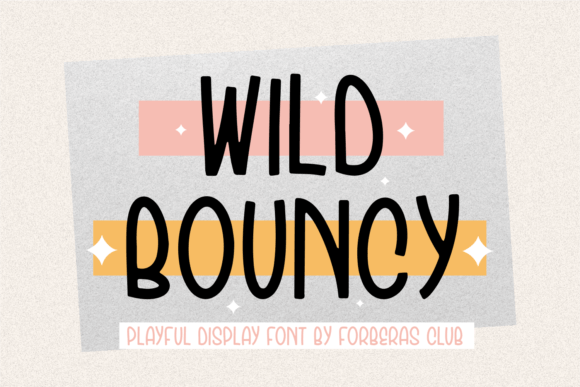
At its core, Wild Bouncy is defined by its rhythmic unpredictability. Unlike many script fonts that attempt to mimic perfect cursive handwriting with consistent slant and spacing, this typeface embraces a more erratic, hand-drawn aesthetic. The term "bouncy" accurately describes the baseline variation; letters do not sit on a straight line but rather dance slightly up and down, creating a sense of movement and organic flow. This characteristic makes it distinct from standard sans-serif or serif display fonts, which prioritize uniformity and grid-based alignment.
The "boho" descriptor often associated with Wild Bouncy refers to its loose, free-spirited structure. The strokes vary in thickness, simulating the pressure changes of a real brush or marker. This texture adds a layer of warmth that digital, vector-perfect fonts often lack. For designers working on projects that require a human touch—such as artisanal product packaging, wedding invitations, or lifestyle brand logos—this imperfection is a feature, not a bug. It signals authenticity and approachability, qualities that are increasingly valued in modern branding.
Evaluating Fit: Where Wild Bouncy Shines
Determining whether Wild Bouncy is the right resource for a project requires analyzing the intended audience and the medium of delivery. This font performs exceptionally well in contexts where the primary goal is to grab attention quickly while maintaining a friendly tone. Its large x-height and open forms ensure readability at larger sizes, making it a strong candidate for headlines, poster titles, and social media graphics.
- Branding for Creative Industries: Businesses in the wellness, craft, food, and children's sectors often benefit from the playful nature of this font. It helps establish a brand identity that feels accessible rather than corporate.
- Event Stationery: For birthday parties, baby showers, and casual weddings, Wild Bouncy adds a celebratory feel without appearing overly formal or stiff.
- Web Graphics and Banners: When used sparingly on websites, particularly in hero sections or call-to-action buttons, it can break the monotony of standard web fonts and guide the user's eye effectively.
However, the effectiveness of Wild Bouncy relies heavily on scale. Because of its irregular baseline and decorative quirks, it is generally unsuitable for body text or small captions. Using it for paragraphs longer than two sentences can cause eye fatigue for the reader, as the brain has to work harder to decode the varying letter heights and shapes. In these scenarios, pairing it with a clean, neutral sans-serif font is a recommended best practice to maintain balance and legibility.
Comparative Analysis: Wild Bouncy vs. Other Styles
When evaluating Wild Bouncy against other typography options, it is helpful to categorize it within the broader landscape of display fonts. Compared to structured script fonts, which offer elegance and formality, Wild Bouncy leans heavily into informality. If a project requires a sense of luxury or high-end sophistication, a refined script with consistent connecting strokes might be a superior alternative. Wild Bouncy, by contrast, communicates fun and spontaneity.
Similarly, when compared to bold slab serifs or geometric sans-serifs, the difference lies in emotional resonance. While a geometric font might convey stability, innovation, or tech-forward thinking, Wild Bouncy conveys emotion and humanity. It is less about precision and more about expression. This trade-off is crucial for designers to consider. Choosing Wild Bouncy means sacrificing some degree of structural rigidity in exchange for character and vibe.
Another point of comparison is the level of "noise" in the design. Some handwritten fonts include excessive splatters, ink bleeds, or distress textures. Wild Bouncy tends to strike a middle ground; it has texture and variation but remains clean enough to be versatile. This makes it more adaptable than highly grunge-style fonts, which can sometimes clash with modern, minimalist design trends. It offers a "clean casual" look that fits well in both digital and print environments without requiring heavy post-processing to ensure clarity.
Practical Limitations and Decision Factors
Despite its strengths, Wild Bouncy is not a universal solution. There are specific limitations that users must acknowledge before integrating it into a workflow. The most significant constraint is accessibility. For users with visual impairments or dyslexia, the irregular baseline and varying letterforms can pose reading challenges. In compliance-driven industries or public sector communications, adhering to accessibility standards (such as WCAG) may necessitate choosing a more uniform typeface.
Furthermore, the context of the message matters. While the font is excellent for positive, uplifting messages, it may undermine the seriousness of sensitive topics. Using a bouncy, playful font for financial reports, legal disclaimers, or somber announcements would create a tonal dissonance that could confuse or alienate the audience. In these instances, the playful rhythm of Wild Bouncy becomes a liability rather than an asset.
Technical considerations also play a role in the decision-making process. When using Wild Bouncy for web graphics, file size and rendering across different browsers should be tested. Handwritten fonts with complex paths can sometimes render differently on low-resolution screens or older devices. Ensuring that the "bounce" translates correctly on mobile devices is a necessary step in the quality assurance process. For print projects, the ink coverage and paper texture should be considered; very thin strokes in handwritten fonts can sometimes disappear on rough, uncoated paper stocks.
Making the Final Choice
Ultimately, deciding to use Wild Bouncy comes down to the narrative you wish to tell. If the story is one of joy, creativity, relaxation, or youthful energy, this font serves as a powerful visual shorthand. It allows designers to inject personality into a layout without relying solely on color or imagery. However, if the project demands strict hierarchy, maximum readability at small sizes, or a tone of serious authority, exploring alternative categories like humanist sans-serifs or traditional serifs would be a more prudent path.
Designers are encouraged to test Wild Bouncy in situ before committing. Create mockups of the actual content, not just placeholder text like "Lorem Ipsum." See how the specific words and phrases interact with the font's unique rhythm. Does the bounce enhance the meaning, or does it distract? By critically evaluating the fit between the typeface's characteristics and the project's goals, creators can ensure that their final composition is not only gorgeous but also effective and appropriate for its intended audience.