Evaluating Woosh Comic: A Practical Guide to Whimsical Display Typography
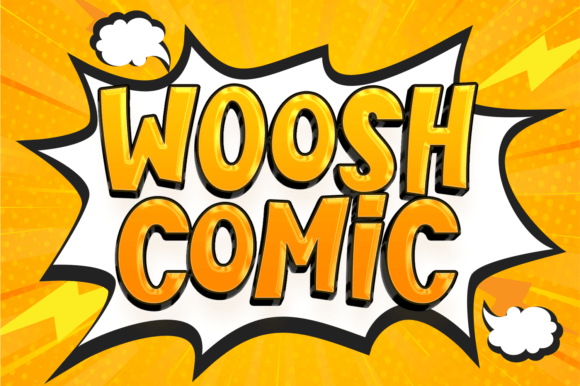
Selecting the right typeface for a creative project often involves balancing personality with legibility. For designers working on branding, packaging, or promotional materials that require a lighthearted tone, Woosh Comic presents a compelling option. This display typeface is characterized by its bold, cartoonish aesthetic, designed specifically to inject a sense of whimsy and energy into visual compositions. Unlike standard sans-serif or serif fonts intended for long-form reading, Woosh Comic serves a decorative function, acting as a primary visual hook rather than a body text solution.
The distinct appeal of this font lies in its ability to mimic hand-drawn lettering while maintaining the structural consistency required for professional design work. Its thick strokes and playful curves make it an ideal candidate for projects targeting younger demographics or those aiming to evoke nostalgia for classic Saturday morning cartoons. However, integrating such a stylized font requires a clear understanding of its strengths and limitations compared to more neutral alternatives.
Defining the Aesthetic and Technical Capabilities
At its core, Woosh Comic is a display font, meaning it is optimized for use at larger sizes where its unique characteristics can be fully appreciated. The "comic" descriptor is accurate; the letterforms feature exaggerated proportions and dynamic angles that suggest movement and fun. This makes it particularly effective for headlines, logos, and poster titles where the goal is to capture attention immediately.
From a technical standpoint, a significant advantage of Woosh Comic is its PUA (Private Use Area) encoding. For designers who may not be familiar with advanced typography tools, this feature simplifies access to the font's full character set. PUA encoding allows users to access alternate glyphs, swashes, and ligatures directly through the character map or via specific keystrokes, without needing complex OpenType feature panels. This lowers the barrier to entry for creating varied and custom-looking text arrangements. Instead of manually drawing variations or switching between multiple font files, a designer can effortlessly toggle between different stylistic alternates to break up repetition in a wordmark or headline.
The colorfulness mentioned in its description often refers to how the font interacts with fill patterns and strokes. Because the letterforms are bold and open, they serve as excellent containers for gradients, textures, or multi-color fills. This versatility allows the type to stand out against busy backgrounds, a common requirement in poster design and merchandise graphics.
Comparative Analysis: Woosh Comic vs. Standard Alternatives
When evaluating Woosh Comic against other options in the display category, it is essential to consider the specific mood each font conveys. Many designers initially gravitate toward generic comic-style fonts that rely heavily on irregular baselines and inconsistent stroke widths to simulate handwriting. While these can feel authentic, they often suffer from poor readability and a lack of professional polish.
In contrast, Woosh Comic offers a more refined approach. It retains the playful spirit of hand-lettering but imposes a level of geometric stability that generic alternatives often lack. This makes it a stronger choice for logo design, where the mark must remain recognizable and scalable across various mediums, from business cards to large-scale signage. A less structured alternative might look charming on a screen but could become illegible or distorted when printed small or embroidered on fabric.
Furthermore, when compared to modern, minimalist sans-serif fonts, Woosh Comic occupies a completely different emotional space. A clean geometric sans-serif communicates efficiency, modernity, and seriousness. Woosh Comic communicates approachability, creativity, and fun. The decision between the two is not about which is "better" in a vacuum, but which aligns with the brand identity. For a tech startup aiming for trust and security, Woosh Comic would likely be a mismatch. However, for a children's party planning service, a toy store, or a casual food truck, the warmth of Woosh Comic provides a competitive edge that a sterile sans-serif cannot match.
Tradeoffs and Limitations
Despite its strengths, Woosh Comic is not a universal solution. The primary tradeoff with any highly stylized display font is readability. The very features that make it distinctive—bold weights, unusual curves, and decorative elements—can hinder legibility at smaller sizes or in dense paragraphs. It is generally inadvisable to use Woosh Comic for body copy, captions, or any text block exceeding a few lines. In these scenarios, pairing it with a highly legible, neutral sans-serif or serif font is the professional standard. This combination allows the headline to grab attention while ensuring the informational content remains easy to digest.
Another consideration is the potential for overuse. Because the font is so expressive, it can dominate a layout if not handled with care. Designers must ensure there is sufficient whitespace around Woosh Comic text to let it breathe. Crowding it with other graphical elements or competing typefaces can result in a chaotic visual experience that dilutes the intended message.
Strategic Applications and Best-Fit Scenarios
Identifying the right context for Woosh Comic is crucial for maximizing its impact. The font excels in environments where the objective is to lower barriers and invite engagement. Here are several practical scenarios where this typeface shines:
- Branding for Youth-Oriented Products: Whether designing packaging for snacks, toys, or educational games, Woosh Comic helps establish an immediate connection with children and parents looking for fun, safe products.
- Event Marketing: Posters and flyers for carnivals, birthday parties, or community festivals benefit from the energetic vibe of the font. It signals to the viewer that the event will be lively and entertaining.
- Casual Food and Beverage: Cafes, ice cream shops, and food trucks often use such typography to convey a relaxed, artisanal, or homemade feel. It suggests that the establishment does not take itself too seriously, focusing instead on enjoyment.
- Digital Content and Social Media: In the realm of social media graphics, where stopping the scroll is paramount, the bold nature of Woosh Comic can make thumbnails and story headers pop against the cluttered feed.
Conversely, there are situations where readers should consider alternative resources. If the project involves legal documents, financial reports, medical information, or high-end luxury goods, the playful nature of Woosh Comic may undermine the necessary gravity and prestige. In these cases, a traditional serif or a restrained sans-serif would be a more appropriate evaluation choice.
Making an Informed Decision
Ultimately, choosing Woosh Comic comes down to the specific narrative you wish to tell through your design. It is a tool specialized for expression rather than utility. Its PUA encoding adds a layer of flexibility that appeals to both novice designers and seasoned professionals looking to speed up their workflow without sacrificing customizability.
Before committing to this font for a major project, it is advisable to test it in the intended medium. Print a sample at the final size to check for legibility issues that might not be apparent on a high-resolution monitor. Experiment with the swashes and alternate glyphs to see if they enhance the composition or create visual noise. By understanding where Woosh Comic fits within the broader landscape of typography—specifically its role as a high-impact display element rather than a workhorse text font—designers can leverage its whimsical qualities effectively. It is not about forcing a square peg into a round hole, but recognizing when a project specifically calls for the vibrant, cartoonish energy that only a font like Woosh Comic can provide.